

Mistletoe Poster

Designed and sold by Navigator
$14.51
20% off ends soon
Style

PosterHeavy poster paper, semigloss finish
$14.51
 Super-easy returnsProblem? No problem. We’ll fix it, fast.
Product features
- Printed on poster paper. Extremely versatile, making it perfect for reproducing both artwork and photographs
- Custom sizes, based on artwork dimensions. Check size chart if self-framing
- Dimensions include a 1 - 2 inch (2.5 - 5.0cm) white border to assist in framing
- Shipped in protective packaging
- Since every item is made just for you by your local third-party fulfiller, there may be slight variances in the product received

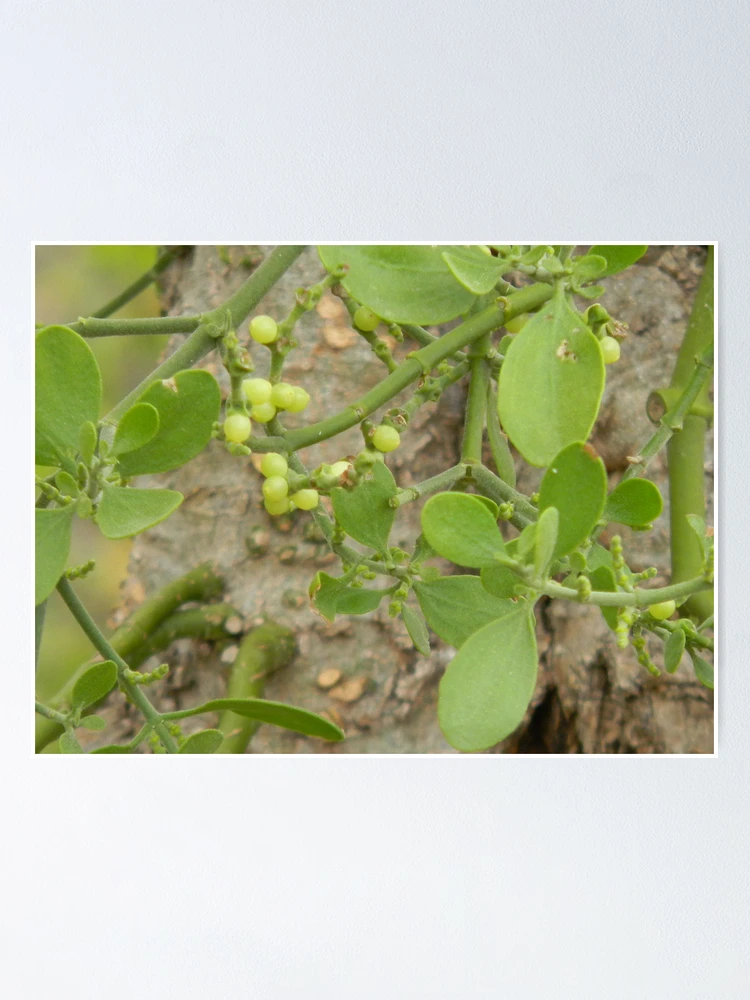
Mistletoe
I like this view, which shows the plant literally growing out of the tree. The roots of the Mistletoe penetrate into the tree and literally steals food from the tree. So it's a thief, a parasitic thief. That's why in this photo it appears that the Mistletoe is actually a branch of the tree, but it's fooling you. Yet, amazingly, its very act of thievery enriches the tree and the forest. Read on to see what Wikipedia reveals.... From Wikipedia: The name was originally applied to Viscum album (European Mistletoe, Santalaceae), the only species native in Great Britain and much of Europe. European mistletoe, Viscum album is readily recognized by its smooth-edged oval evergreen leaves borne in pairs along the woody stem, and waxy white berries in dense clusters of 2 to 6. In America the genus Viscum does not grow wild but the Eastern Mistletoe (in the genus Phoradendron) is similar, but has shorter, broader leaves and longer clusters of 10 or more berries. Mistletoe plants grow on a wide range of host trees, and commonly reduce their growth but can kill them with heavy infestation. Viscum album can parasitise more than 200 tree and shrub species. All mistletoes are hemi-parasites, bearing evergreen leaves that do some photosynthesis, and using the host mainly for water and mineral nutrients. However, the mistletoe first sprouts from bird feces[citation needed] on the trunk of the tree and in its early stages of life it takes nutrients from this source.[citation needed] Species more or less completely parasitic include the leafless quintral, Tristerix aphyllus, which lives deep inside the sugar-transporting tissue of a spiny cactus, appearing only to show its tubular red flowers,6 and the genus Arceuthobium (dwarf mistletoe; Santalaceae) which has reduced photosynthesis; as an adult, it manufactures only a small proportion of the sugars it needs from its own photosythesis but as a seedling it actively photosynthesizes until a connection to the host is established. Some species of the largest family, Loranthaceae, have small, insect-pollinated flowers (as with Santalaceae), but others have spectacularly showy, large, bird-pollinated flowers. Most mistletoe seeds are spread by birds, such as the Mistle Thrush in Europe, the Phainopepla in southwestern North America, and Dicaeum of Asia and Australia. However, distinguishing between these species and ones of other ecological biomes is not difficult. They derive sustenance and agility through eating the fruits and nuts (drupes). The seeds are excreted in their droppings and stick to twigs, or more commonly the bird grips the fruit in its bill, squeezes the sticky coated seed out to the side, and then wipes its bill clean on a suitable branch.[citation needed] The seeds are coated with a sticky material called viscin (containing both cellulosic strands and mucopolysaccharides), which hardens and attaches the seed firmly to its future host. Mistletoe was often considered a pest that kills trees and devalues natural habitats, but was recently recognized as an ecological keystone species, an organism that has a disproportionately pervasive influence over its community.7 A broad array of animals depend on mistletoe for food, consuming the leaves and young shoots, transferring pollen between plants, and dispersing the sticky seeds. The dense evergreen witches' brooms formed by the dwarf mistletoes (Arceuthobium species) of western North America also make excellent locations for roosting and nesting of the Northern Spotted Owls and the Marbled Murrelets. In Australia the Diamond Firetails and Painted Honeyeaters are recorded as nesting in different mistletoes. This behavior is probably far more widespread than currently recognized; more than 240 species of birds that nest in foliage in Australia have been recorded nesting in mistletoe, representing more than 75% of the resident avifauna.[citation needed] A study of mistletoe in junipers concluded that more juniper berries sprout in stands where mistletoe is present, as the mistletoe attracts berry-eating birds which also eat juniper berries.8 Such interactions lead to dramatic influences on diversity, as areas with greater mistletoe densities support higher diversities of animals. Thus, rather than being a pest, mistletoe can have a positive effect on biodiversity, providing high quality food and habitat for a broad range of animals in forests and woodlands worldwide. This plant is poisonous.
Also available on


Looking for something different?
Search below.Related Tags
Posters Tags
This section provides a collection of tags that relate to the Poster on this page. These tags each link to a search for the Posters that relate to the tag.
All Product Tags
This section provides a collection of tags that each link to a search for any products that relate to the tag.
Trending topics
This section provides a collection of tags that each link to a search for any products that relate to the tag.
Secure Payments
100% Secure Payment with 256-bit SSL encryption