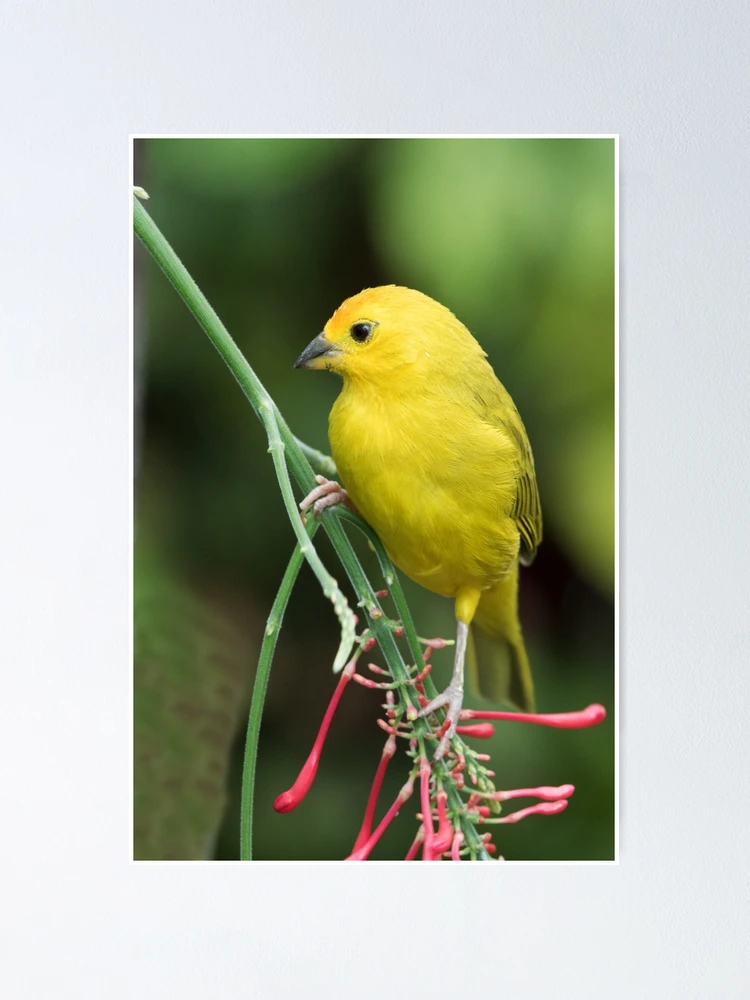


Saffron Finch Poster

Designed and sold by WorldDesign
$30.22
Style

PosterHeavy poster paper, semigloss finish
$30.22
 Super-easy returnsProblem? No problem. We’ll fix it, fast.
Product features
- Printed on poster paper. Extremely versatile, making it perfect for reproducing both artwork and photographs
- Custom sizes, based on artwork dimensions. Check size chart if self-framing
- Dimensions include a 1 - 2 inch (2.5 - 5.0cm) white border to assist in framing
- Shipped in protective packaging
- Since every item is made just for you by your local third-party fulfiller, there may be slight variances in the product received

Saffron Finch
The saffron finch (Sicalis flaveola) is a tanager from South America that is common in open and semi-open areas in lowlands outside the Amazon Basin. They have a wide distribution in Colombia, northern Venezuela (where it is called "canario de tejado" or "roof canary"), western Ecuador, western Peru, eastern and southern Brazil (where it is called "canário da terra" or "native canary"), Bolivia, Paraguay, Uruguay, northern Argentina, and Trinidad and Tobago. It has also been introduced to Hawaii, Puerto Rico and elsewhere. Although commonly regarded as a canary, it is not related to the Atlantic canary. Formerly, it was placed in the Emberizidae but it is close to the seedeaters. The male is bright yellow with an orange crown which distinguishes it from most other yellow finches (the exception being the orange-fronted yellow finch). The females are more confusing and are usually just a slightly duller version of the male, but in the southern subspecies S. f. pelzelni they are olive-brown with heavy dark streaks.
Typically nesting in cavities, the saffron finch makes use of sites such as abandoned rufous hornero (Furnarius rufus) nests, bamboo branches and under house roofs - this species is tolerant of human proximity, appearing at suburban areas and frequenting bird tables. They have a pleasant but repetitious song which, combined with their appearance, has led to them being kept as caged birds in many areas. Males are polygamous, mating with two females during the nesting season, and territorial, which has led to the species being used for blood sporting with two males put in a cage in order to fight.
Source: Wikipedia
Also available on



Looking for something different?
Search below.Related Tags
Posters Tags
This section provides a collection of tags that relate to the Poster on this page. These tags each link to a search for the Posters that relate to the tag.
All Product Tags
This section provides a collection of tags that each link to a search for any products that relate to the tag.
Trending topics
This section provides a collection of tags that each link to a search for any products that relate to the tag.
Secure Payments
100% Secure Payment with 256-bit SSL encryption