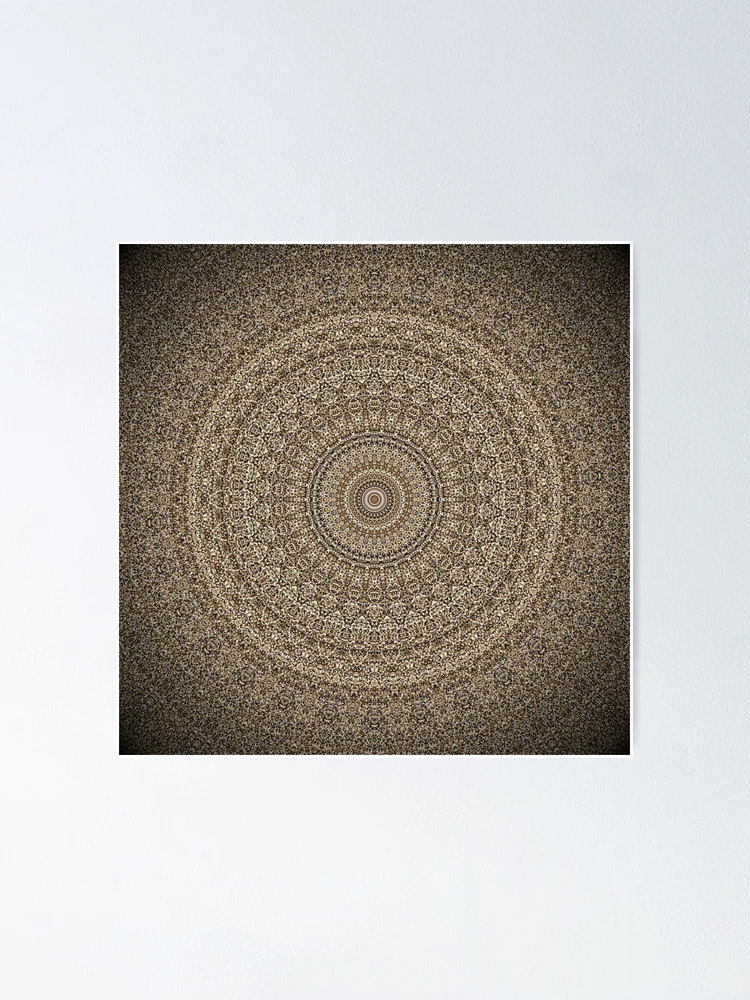


Mandala Pattern, Brown Poster

Designed and sold by PromoteProgress
$16.93
20% off ends soon
Style

PosterHeavy poster paper, semigloss finish
$16.93
 Super-easy returnsProblem? No problem. We’ll fix it, fast.
Product features
- Printed on poster paper. Extremely versatile, making it perfect for reproducing both artwork and photographs
- Custom sizes, based on artwork dimensions. Check size chart if self-framing
- Dimensions include a 1 - 2 inch (2.5 - 5.0cm) white border to assist in framing
- Shipped in protective packaging
- Since every item is made just for you by your local third-party fulfiller, there may be slight variances in the product received

Mandala Pattern, Brown
A mandala (emphasis on first syllable; Sanskrit मण्डल, maṇḍala – literally "circle") is a spiritual and ritual symbol in Hinduism and Buddhism, representing the universe. In common use, "mandala" has become a generic term for any diagram, chart or geometric pattern that represents the cosmos metaphysically or symbolically; a microcosm of the universe. The basic form of most mandalas is a square with four gates containing a circle with a center point. Each gate is in the general shape of a T. Mandalas often have radial balance. The term appears in the Rigveda as the name of the sections of the work, and Vedic rituals use mandalas such as the Navagraha mandala to this day. Mandalas are also used in Buddhism. In various spiritual traditions, mandalas may be employed for focusing attention of practitioners and adepts, as a spiritual guidance tool, for establishing a sacred space and as an aid to meditation and trance induction. Vajrayana Buddhism In Vajrayana Buddhism, mandalas have been developed also into sandpainting. They are also a key part of Anuttarayoga Tantra meditation practices. Visualisation of Vajrayana teachings The mandala can be shown to represent in visual form the core essence of the Vajrayana teachings. The mind is "a microcosm representing various divine powers at work in the universe."9 The mandala represents the nature of the Pure Land, Enlightened mind. An example of this type of mandala is Vajrabhairava mandala a silk tapestry woven with gilded paper depicting lavish elements like crowns and jewelry, which gives a three-dimensional effect to the piece.1011 Mount Meru A mandala can also represent the entire universe, which is traditionally depicted with Mount Meru as the axis mundi in the center, surrounded by the continents.12 One example is the Cosmological Mandala with Mount Meru, a silk tapestry from the Yuan dynasty that serves as a diagram of the Tibetan cosmology, which was given to China from Nepal and Tibet.1314 Wisdom and impermanence In the mandala, the outer circle of fire usually symbolises wisdom. The ring of eight charnel grounds15 represents the Buddhist exhortation to be always mindful of death, and the impermanence with which samsara is suffused: "such locations were utilized in order to confront and to realize the transient nature of life".16 Described elsewhere: "within a flaming rainbow nimbus and encircled by a black ring of dorjes, the major outer ring depicts the eight great charnel grounds, to emphasize the dangerous nature of human life".17 Inside these rings lie the walls of the mandala palace itself, specifically a place populated by deities and Buddhas. Five Buddhas One well-known type of mandala is the mandala of the "Five Buddhas", archetypal Buddha forms embodying various aspects of enlightenment. Such Buddhas are depicted depending on the school of Buddhism, and even the specific purpose of the mandala. A common mandala of this type is that of the Five Wisdom Buddhas (a.k.a. Five Jinas), the Buddhas Vairocana, Aksobhya, Ratnasambhava, Amitabha and Amoghasiddhi. When paired with another mandala depicting the Five Wisdom Kings, this forms the Mandala of the Two Realms. Practice Tantric mandala of Vajrayogini Mandalas are commonly used by tantric Buddhists as an aid to meditation. The mandala is "a support for the meditating person",18 something to be repeatedly contemplated to the point of saturation, such that the image of the mandala becomes fully internalised in even the minutest detail and can then be summoned and contemplated at will as a clear and vivid visualized image. With every mandala comes what Tucci calls "its associated liturgy... contained in texts known as tantras",19 instructing practitioners on how the mandala should be drawn, built and visualised, and indicating the mantras to be recited during its ritual use. By visualizing "pure lands", one learns to understand experience itself as pure, and as the abode of enlightenment. The protection that we need, in this view, is from our own minds, as much as from external sources of confusion. In many tantric mandalas, this aspect of separation and protection from the outer samsaric world is depicted by "the four outer circles: the purifying fire of wisdom, the vajra circle, the circle with the eight tombs, the lotus circle".18 The ring of vajras forms a connected fence-like arrangement running around the perimeter of the outer mandala circle.20 As a meditation on impermanence (a central teaching of Buddhism), after days or weeks of creating the intricate pattern of a sand mandala, the sand is brushed together into a pile and spilled into a body of running water to spread the blessings of the mandala. Kværne21 in his extended discussion of sahaja, discusses the relationship of sadhana interiority and exteriority in relation to mandala thus:...external ritual and internal sadhana form an indistinguishable whole, and this unity finds its most pregnant expression in the form of the mandala, the sacred enclosure consisting of concentric squares and circles drawn on the ground and representing that adamant plane of being on which the aspirant to Buddha hood wishes to establish himself. The unfolding of the tantric ritual depends on the mandala; and where a material mandala is not employed, the adept proceeds to construct one mentally in the course of his meditation."22 Offerings Chenrezig sand mandala created at the House of Commons of the United Kingdom on the occasion of the Dalai Lama's visit in May 2008 A "mandala offering"23 in Tibetan Buddhism is a symbolic offering of the entire universe. Every intricate detail of these mandalas is fixed in the tradition and has specific symbolic meanings, often on more than one level. Whereas the above mandala represents the pure surroundings of a Buddha, this mandala represents the universe. This type of mandala is used for the mandala-offerings, during which one symbolically offers the universe to the Buddhas or to one's teacher. Within Vajrayana practice, 100,000 of these mandala offerings (to create merit) can be part of the preliminary practices before a student even begins actual tantric practices.24 This mandala is generally structured according to the model of the universe as taught in a Buddhist classic text the Abhidharma-kośa, with Mount Meru at the centre, surrounded by the continents, oceans and mountains, etc. Shingon Buddhism One Japanese branch of Mahayana Buddhism—Shingon Buddhism—makes frequent use of mandalas in its rituals as well, though the actual mandalas differ. When Shingon's founder, Kukai, returned from his training in China, he brought back two mandalas that became central to Shingon ritual: the Mandala of the Womb Realm and the Mandala of the Diamond Realm. These two mandalas are engaged in the abhiseka initiation rituals for new Shingon students, more commonly known as the Kechien Kanjō (結縁灌頂). A common feature of this ritual is to blindfold the new initiate and to have them throw a flower upon either mandala. Where the flower lands assists in the determination of which tutelary deity the initiate should follow. Sand mandalas, as found in Tibetan Buddhism, are not practiced in Shingon Buddhism. Nichiren Buddhism The mandala in Nichiren Buddhism is called a moji-mandala (文字曼陀羅) and is a paper hanging scroll or wooden tablet whose inscription consists of Chinese characters and medieval-Sanskrit script representing elements of the Buddha's enlightenment, protective Buddhist deities, and certain Buddhist concepts. Called the Gohonzon, it was originally inscribed by Nichiren, the founder of this branch of Japanese Buddhism, during the late 13th Century. The Gohonzon is the primary object of veneration in some Nichiren schools and the only one in others, which consider it to be the supreme object of worship as the embodiment of the supreme Dharma and Nichiren's inner enlightenment. The seven characters Namu Myōhō Renge Kyō, considered to be the name of the supreme Dharma, as well as the invocation that believers chant, are written down the center of all Nichiren-sect Gohonzons, whose appearance may otherwise vary depending on the particular school and other factors. Pure Land Buddhism Mandalas have sometimes been used in Pure Land Buddhism to graphically represent Pure Lands, based on descriptions found in the Larger Sutra and the Contemplation Sutra. The most famous mandala in Japan is the Taima mandala, dated to about 763 CE. The Taima mandala is based on the Contemplation Sutra, but other similar mandalas have been made subsequently. Unlike mandalas used in Vajrayana Buddhism, it is not used as an object of meditation or for esoteric ritual. Instead, it provides a visual representation of the Pure Land texts, and is used as a teaching aid.[citation needed] Also in Jodo Shinshu Buddhism, Shinran and his descendant, Rennyo, sought a way to create easily accessible objects of reverence for the lower-classes of Japanese society. Shinran designed a mandala using a hanging scroll, and the words of the nembutsu (南無阿彌陀佛) written vertically. This style of mandala is still used by some Jodo Shinshu Buddhists in home altars, or butsudan. -Wikipedia
Also available on




Looking for something different?
Search below.Related Tags
Posters Tags
This section provides a collection of tags that relate to the Poster on this page. These tags each link to a search for the Posters that relate to the tag.
All Product Tags
This section provides a collection of tags that each link to a search for any products that relate to the tag.
Trending topics
This section provides a collection of tags that each link to a search for any products that relate to the tag.
Secure Payments
100% Secure Payment with 256-bit SSL encryption


