


WW II Camera iPhone Case

Designed and sold by WorldDesign
$27.06
25% off ends soon
$27.06
 Super-easy returnsProblem? No problem. We’ll fix it, fast.
Product features
- Double layer clip-on protective case with extra durability
- Impact resistant polycarbonate shell and shock absorbing inner TPU liner
- Super-bright colors embedded directly into the case
- Secure fit with design wrapping around side of the case and full access to ports
- Compatible with Qi-standard wireless charging
- iPhone SE (2020) / iPhone 8 cases also fit iPhone SE (2022)
- Weight 30g
- Thickness 1/8 inch (3mm)
- Since every item is made just for you by your local third-party fulfiller, there may be slight variances in the product received
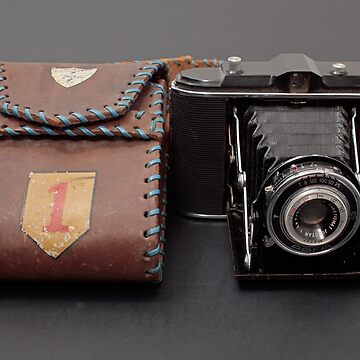
WW II Camera
During World War II, my father served in the 1st Infantry Division. This was his camera and case. The emblem on the case represents the 1st Infantry Division. After the war, my father served as a guard at the Nuremberg trials.
The First Infantry Division and one regimental combat team from the 29th Infantry Division comprised the first wave of troops that assaulted German Army defenses on Omaha Beach on D-Day with some of the division's units suffering 30 percent casualties in the first hour of the assault, and secured Formigny and Caumont in the beachhead by the end of the day. The division followed up the Saint-Lô break-through with an attack on Marigny, 27 July 1944, and then drove across France in a continuous offensive, reaching the German border at Aachen in September. The division laid siege to Aachen, taking the city after a direct assault on 21 October 1944. The First then attacked east of Aachen through the Hurtgen Forest, driving to the Rur, and was moved to a rear area 7 December 1944 for refitting and rest following 6 months of combat. When the German Wacht Am Rhein offensive (commonly called the Battle of the Bulge) was launched on 16 December 1944, the division was quickly moved to the Ardennes front. Fighting continuously from 17 December 1944 to 28 January 1945, the division helped to blunt and reverse the German offensive. Thereupon, the division attacked and again breached the Siegfried Line, fought across the Rur, 23 February 1945, and drove on to the Rhine, crossing at the Remagen bridgehead, 15–16 March. The division broke out of the bridgehead, took part in the encirclement of the Ruhr Pocket, captured Paderborn, pushed through the Harz Mountains, and was in Czechoslovakia, fighting at Kinsperk, Sangerberg, and Mnichov when the war in Europe ended.
The Agfa Isolette (Jsolette) camea is a horizontal-folding medium format camera made by Agfa Kamerawerk AG, Munich, Germany. This folding camera first came on the market as the Isorette (Jsorette) but the name changed to Isolette (Jsolette) quite soon. From late 1937 the name writing form of I (like J) changed again to Isolette. This means that very early 1936/37 models have a Jsolette writing on the front plate leatherette of the camera. Isolette production lasted till 1942. This model was called in Germany during the WWII times the "Soldatenkamera" (Soldiers' Camera) also. One of the very distinctive feature is the top-plate which is made of a plastic called "Trolitan". There were many different lens/shutter combinations.
Also available on


Looking for something different?
Search below.Related Tags
iPhone Cases Tags
This section provides a collection of tags that relate to the iPhone Case on this page. These tags each link to a search for the iPhone Cases that relate to the tag.
All Product Tags
This section provides a collection of tags that each link to a search for any products that relate to the tag.
Trending topics
This section provides a collection of tags that each link to a search for any products that relate to the tag.
Secure Payments
100% Secure Payment with 256-bit SSL encryption


