Old Cable Tool Rig Clock

Designed and sold by Carla Jensen
$35.94
15% off ends soon
$35.94
 Super-easy returnsProblem? No problem. We’ll fix it, fast.
View size guideFind your fit
Product features
- It's always art o'clock when your clock is a work of art
- Printed polypropylene face made for you when you order
- Metal hands in your choice of colors
- Bamboo wood frame in black, white, or natural finish
- Quartz clock mechanism for accurate timekeeping
- Clear plexiglass lens
- Built-in rear hook, ready to hang
- AA battery not included
- Since every item is made just for you by your local third-party fulfiller, there may be slight variances in the product received

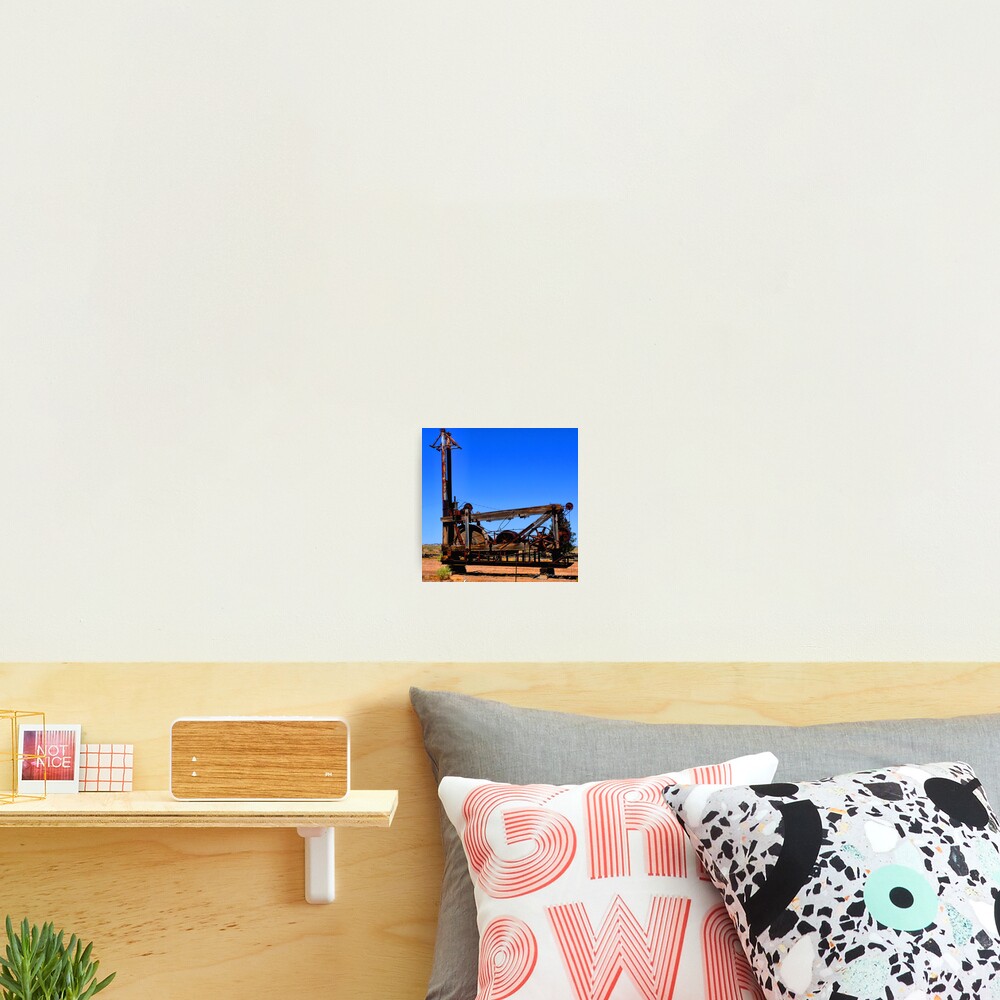
Old Cable Tool Rig
A little bit of history on this....and this one is missing a few pieces to it Cable tool rigs were widely used from about 1870 and are still being used today, although almost all of today's oil wells are drilled using a rotary rig. All the pre-1950 Elsmere Canyon wells were drilled with cable tools rigs. The basic machinery consisted of the engine and boiler, the derrick and crown block, the bullwheel and drilling cable, the sandwheel and sanding line for the bailer, the vertical bandwheel with a center crank, and the walking beam supported by the samson post. Bandwheels were essentially large pulleys (usually 8-10ft in diameter) driven by a leather belt from the engine, which reduced the engine rpms and increased power. A crank on the bandwheel's axle imparted up-and-down motion (via a pitman) to the walking beam, the other end of which was connected to the drilling cable by the temper screw. The walking beam alternately raised and lowered the drilling tools. Walking beams were typically 26ft x 12in x24x in size. Bullwheels and sandwheels were spools for the drilling cable and sanding (or bailing) line, respectively. Additionally, fishing tools, various hand tools, wrenches, and forge tools were required for the drilling process. "Spudding" was the process of starting the oil well. Since the complete string of cable tools was 40-ft. long or more, there was not enough headroom to drill with the walking beam until a depth of at least 60-ft. was obtained. The first 60-ft to 100-ft. was therefore drilled by spudding, a process that did not involve the use of the walking beam. Below is a typical spudding rig setup (from Uren, 1946 - see oil sources). A special spudding bit is used along with a special set-up (see below). The crank was disconnected from the walking beam and a rope was connected between it and the drilling cable. The crank jerked the rope on each revolution, which in turn jerked the drilling cable and caused the drill bit to rise and fall in the hole. As the well got deeper, the bull wheel (which holds the drilling line and had been locked in place) was released to let more cable out. When the well became too filled, this process was interrupted to bail out the loose material. When the right depth had been reached, the spudding equipment was removed and the complete set of cable tools with a normal drilling bit were assembled and carefully lowered into the well. This was called "hitching on". The drilling bit, along with the cable, could reach weights of 3600 lbs or more. The early rigs were powered with steam. Steam was delivered from the boiler to the engine by way of pipe. The engine powered the band wheel by a turning belt. A well-braced upright post, called the sampson post, was mounted further down the platform. On top of it, and mounted with a hinge, laid the horizontal walking beam. The band wheel was connected to one end of the walking beam by a pitman and crank. As the band wheel turned the crank, the pitman was raised and lowered which rocked the walking beam up and down on the sampson post like a teeter-totter. A temper screw was attached to the other end of the walking beam. At one end of the temper screw there was a clamping device that gripped the drilling line to which the cable tool bits were attached. The drilling line came from the bull wheel and ran over a pulley at the top of the derrick. The bits, which were basically just pointed steel weights, pounded the well into the ground. The action at the bottom of the well was one of crushing, not chipping or cutting of the rock. The walking beam raised and lowered the bits about two feet. If the complete drilling tool string weighed 1200 lbs (and some weighed up to 3000 lbs) and the velocity was 6 feet per second, the the force of the blow would be over 16 tons. After a while, the bit had to be replaced. In soft formations, progress could average 30 feet per day, sometimes less, sometimes more, depending on the conditions. The equipment was run 24 hours a day. The drilling was controlled by a skilled worker who, by feeling the line from time to time, could tell what was going on in the well. When necessary, he could let out more line or stop the walking beam. When the bottom of the hole became clogged with rock chips, the bit was raised and a bailer (attached to the the sand line on the sandwheel) was lowered into the well to scoop out the debris. This involved a complicated process of raising the drilling cable with bit out of the well and lowering a bailer bit from the sand line. The bailer then had to be lowered and raised multiple times until it collected enough material. Then it had be raised out of the well and emptied. This had to be done until the well was cleared of loose material. After that, the drilling cable was lowered into the well and the whole process started again. This pound and bail process was repeated about every three feet. The calf wheel contained the casing line. When casing was necessary for the well, the casing line was used to lower it into the well. The headache post was a safety feature that kept the walking beam from dropping if anything came loose at the other end of the beam. As greater depths were reached, control became increasingly difficult. The cable became longer, heavier, and had more elasticity. Water often become an issue. Subsurface pressures could not be controlled causing frequent blowouts. An experienced driller was a big asset. Rotary drilling rigs began replacing cable tool rigs in the early 1900's, but did not really take over until the 1940's. Today, cable tool rigs mainly drill water wells and other non-oil holes. Info on history was found at...www.elsmere.com This was taken in Carlsbad, New Mexico with a Panasonic FZ50 Old Cable Tool Rig
Also available on



Looking for something different?
Search below.Related Tags
Clocks Tags
This section provides a collection of tags that relate to the Clock on this page. These tags each link to a search for the Clocks that relate to the tag.
All Product Tags
This section provides a collection of tags that each link to a search for any products that relate to the tag.
Trending topics
This section provides a collection of tags that each link to a search for any products that relate to the tag.
Secure Payments
100% Secure Payment with 256-bit SSL encryption