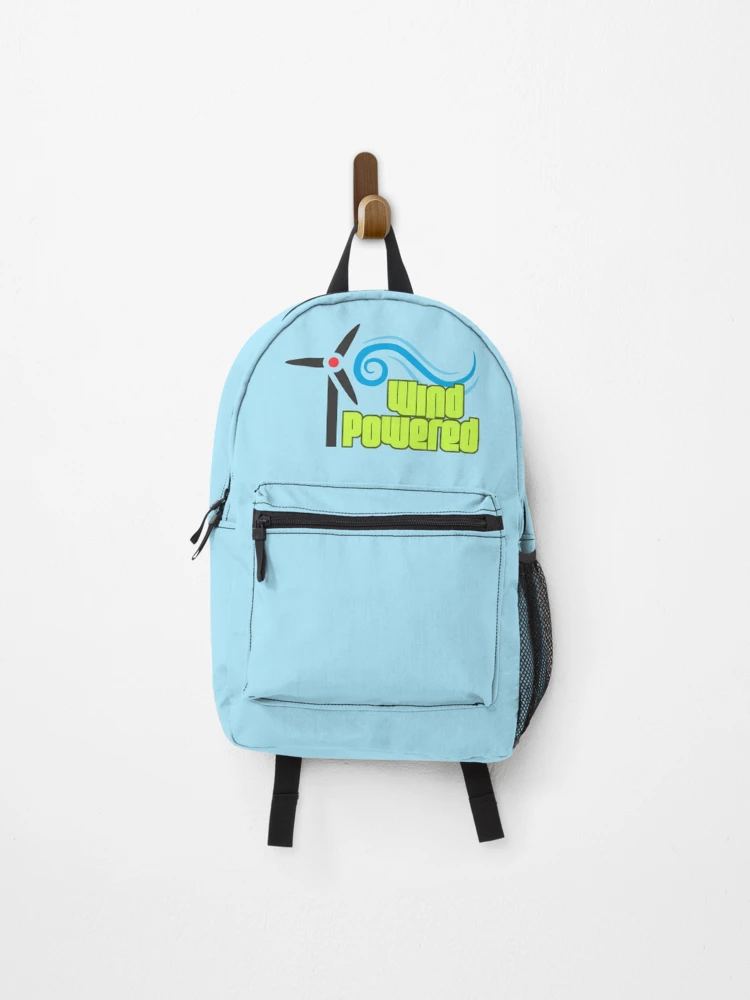


Wind Powered Backpack

Designed and sold by PromoteProgress
$47.59
20% off ends in
07H
53M
05S
$47.59

Product features
- Carry your stuff, express yourself, keep your hands free, it's win-win-win
- Bag measures 17.7 x 11.8 x 4.9in / 45 x 30 x 12.5 cm
- Most standard laptops fit in the internal laptop pocket, which measures 13.5" x 10.5" / 34 x 27 cm
- Durable 100% polyester shell
- Vivid all-over design, sublimation printed for you when you order
- External mesh pocket and adjustable padded straps
- For a different style, check out the Drawstring Bag
- For more space, try the Duffle Bag
- Since every item is made just for you by your local third-party fulfiller, there may be slight variances in the product received

Wind Powered
Wind Powered Wind power is the use of air flow through wind turbines to provide the mechanical power to turn electric generators. Wind power, as an alternative to burning fossil fuels, is plentiful, renewable, widely distributed, clean, produces no greenhouse gas emissions during operation, consumes no water, and uses little land.3[better source needed] The net effects on the environment are far less problematic than those of fossil fuel sources. Wind farms consist of many individual wind turbines, which are connected to the electric power transmission network. Onshore wind is an inexpensive source of electric power, competitive with or in many places cheaper than coal or gas plants.456 Offshore wind is steadier and stronger than on land and offshore farms have less visual impact, but construction and maintenance costs are considerably higher. Small onshore wind farms can feed some energy into the grid or provide electric power to isolated off-grid locations.7 Wind power gives variable power, which is very consistent from year to year but has significant variation over shorter time scales. It is therefore used in conjunction with other electric power sources to give a reliable supply. As the proportion of wind power in a region increases, a need to upgrade the grid and a lowered ability to supplant conventional production can occur.89 Power-management techniques such as having excess capacity, geographically distributed turbines, dispatchable sources, sufficient hydroelectric power, exporting and importing power to neighboring areas, energy storage, or reducing demand when wind production is low, can in many cases overcome these problems.1011 Weather forecasting permits the electric-power network to be readied for the predictable variations in production that occur.121314 In 2017, global wind power capacity expanded 10% to 539 GW.15. Yearly wind energy production grew 17% reaching 4.4% of worldwide electric power usage,16 and providing 11.6% of the electricity in the European Union.17 Denmark is the country with the highest penetration of wind power, with 43.4% of its consumed electricity from wind in 2017.1819 At least 83 other countries around the world are using wind power to supply their electric power grids. Wikipedia, CC by SA 3.0
Also available on


Looking for something different?
Search below.Related Tags
Backpacks Tags
This section provides a collection of tags that relate to the Backpack on this page. These tags each link to a search for the Backpacks that relate to the tag.
All Product Tags
This section provides a collection of tags that each link to a search for any products that relate to the tag.
Trending topics
This section provides a collection of tags that each link to a search for any products that relate to the tag.
Secure Payments
100% Secure Payment with 256-bit SSL encryption


