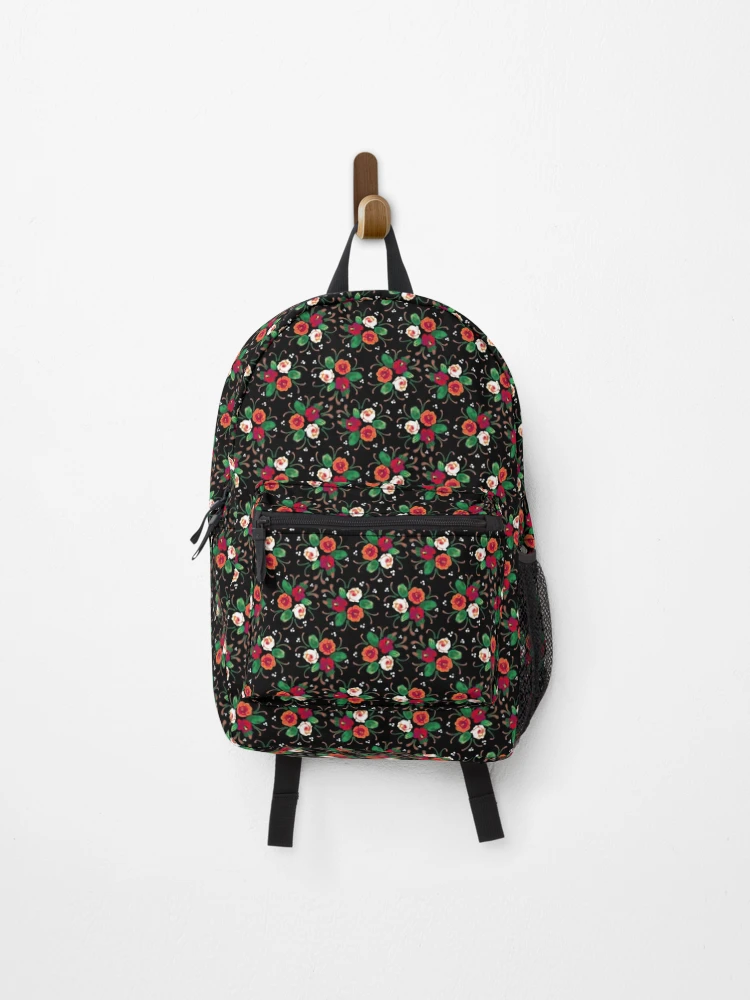


Narrowboat Roses Backpack

Designed and sold by weavernap
$43.34
15% off ends soon
$43.34
 Super-easy returnsProblem? No problem. We’ll fix it, fast.
View size guideFind your fit
Product features
- Carry your stuff, express yourself, keep your hands free, it's win-win-win
- Bag measures 17.7 x 11.8 x 4.9in / 45 x 30 x 12.5 cm
- Most standard laptops fit in the internal laptop pocket, which measures 13.5" x 10.5" / 34 x 27 cm
- Durable 100% polyester shell
- Vivid all-over design, sublimation printed for you when you order
- External mesh pocket and adjustable padded straps
- For a different style, check out the Drawstring Bag
- For more space, try the Duffle Bag
- Since every item is made just for you by your local third-party fulfiller, there may be slight variances in the product received

Narrowboat Roses
Canal Narrowboat Painted decoration (text from Wikipedia)
By the end of the 19th century it was common practice to paint roses and castles on narrow boats and their fixtures and fittings. Common sites include the doors to the cabin, the water can or barrel and the side of the boat along with ornate lettering giving the boat's name and owner. This tradition did not happen in all regions, the Chesterfield Canal being one waterway where narrow boats never bore such decorations.
The origin of the roses and castles found on canal boats is unclear. The first written reference to them appears to be in an 1858 edition of the magazine Household Words in one of a series of articles titled "On the Canal", showing that the art form must have existed by this date. For some time, a popular suggestion was that it had some form of Romani origin; however, there does not appear to be a significant link between the Romani and boating communities. Other suggestions include transfer of styles from the clock-making industry (in particular the decoration on the face), the japanning industry or the pottery industry. There is certainly a similarity in style and a geographical overlap, but no solid proof of a link. There are similar styles of folk art in Scandinavia, Germany, Turkey and Bangladesh.
In the 18th century, similar Dutch Hindeloopen paintwork would only have been a sailing barge journey away from the Thames. There is also an article in the Midland Daily Telegraph of 22 July 1914 that credits the practice of painting of water cans, at least, to a Mr Arthur Atkins.
While the practice declined as commercial use of the canals dwindled, it has seen something of a revival in recent times with the emergence of leisure boating. Narrowboat decoration with roses and castle themes are a common sight on today's canals, although these may utilise cheaper printed vinyl transfers in place of the traditional craft of hand-painted designs.
Also available on


Looking for something different?
Search below.Related Tags
Backpacks Tags
This section provides a collection of tags that relate to the Backpack on this page. These tags each link to a search for the Backpacks that relate to the tag.
All Product Tags
This section provides a collection of tags that each link to a search for any products that relate to the tag.
Trending topics
This section provides a collection of tags that each link to a search for any products that relate to the tag.
Secure Payments
100% Secure Payment with 256-bit SSL encryption