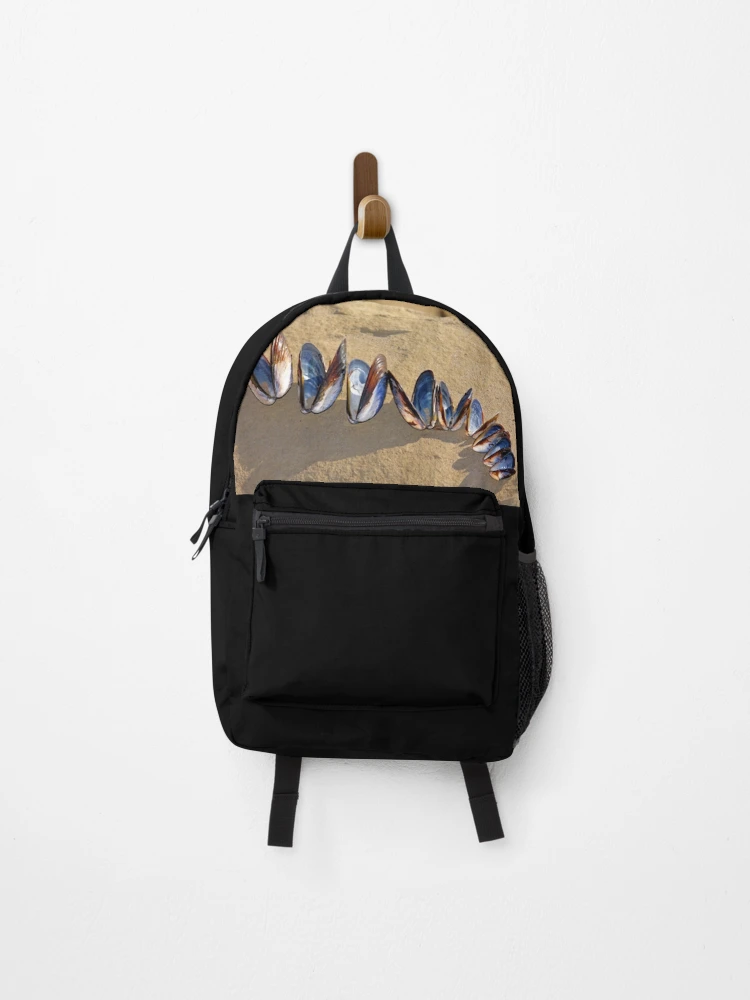


Mussel Shell Line Up Backpack

Designed and sold by CarolM
$44.19
20% off ends soon
$44.19
 Super-easy returnsProblem? No problem. We’ll fix it, fast.
View size guideFind your fit
Product features
- Carry your stuff, express yourself, keep your hands free, it's win-win-win
- Bag measures 17.7 x 11.8 x 4.9in / 45 x 30 x 12.5 cm
- Most standard laptops fit in the internal laptop pocket, which measures 13.5" x 10.5" / 34 x 27 cm
- Durable 100% polyester shell
- Vivid all-over design, sublimation printed for you when you order
- External mesh pocket and adjustable padded straps
- For a different style, check out the Drawstring Bag
- For more space, try the Duffle Bag
- Since every item is made just for you by your local third-party fulfiller, there may be slight variances in the product received

Mussel Shell Line Up
Photographed along the California coast. Someone painstakingly arranged this mussel lineup. They remind me of butterflies. Lol. Canon D40.
The mussel is enclosed in two shells which are opened with the use of a ligament and closed with the aid of a large adductor muscle.
They are usually found clumping together on wave-washed rocks or other hard surfaces which anchors them against the force of the waves. They secrete thread-like structures alled byssus threads which are composed of proteins. With the help of its foot, the threads are glued to its shell and to the foundation to which it is attached to keep it stable. The more the mussel is exposed to waves and currents, the more byssus threads it develops. If the mussel should need to move, it cuts off its threads and develops new ones later.
Mussels filter their food (plankton and other microscopic organisms) from the water.
During the spring, when water temperatures rise, the mussel begins to mate. Mussels have different sexes. The males release its milk into the water. This is sensed by the females which immediately releasing their eggs into the water. A female of average size can release between 5-12 million eggs. In 24 hours the eggs transform into larvae with a shell, sail and a characteristic black eye. They live in a suspended stage for about 3-4 weeks, whereupon they start the second stage of their life - the attached stage. The mussel starts looking for a suitable foundation to attach itself to. It examines the different surfaces and when it finds a suitable one, it attaches itself with a few byssus threads.
Predation of blue mussels by jellyfish an fish larvae is greatest during the 3 weeks it spends as a planktonic larva. Later they are consumed by sea gulls and starfish.
Traditionally, mussels have been used for food, tools, and jewelry. Pieces of mussel shell are used in the process of stimulating production of cultured pearls from oysters. Before plastics, mussel shells were popular for production of buttons.
As for all shellfish, mussels should be alive just before they are cooked because they quickly become toxic after they die. Mussel poisoning due to toxic planktonic organisms is a potential danger along some coastlines. For instance, mussels should be avoided along the west coast of the United States during the warmer months. This is usually caused by dinoflagellates creating elevated levels of toxins in the water that do not harm the mussels, but if consumed by humans can bring on illness.
Blue mussels like these, are found on the North Atlantic and North Pacific coast of North America, Europe, and in other temperate and polar waters around the world.
Info taken from internet resources
.
Also available on


Looking for something different?
Search below.Related Tags
Backpacks Tags
This section provides a collection of tags that relate to the Backpack on this page. These tags each link to a search for the Backpacks that relate to the tag.
All Product Tags
This section provides a collection of tags that each link to a search for any products that relate to the tag.
Trending topics
This section provides a collection of tags that each link to a search for any products that relate to the tag.
Secure Payments
100% Secure Payment with 256-bit SSL encryption


